

This guide explains each system from what Valve and FACEIT publish themselves (Steam Support, the CS2 release notes, FACEIT’s help center), with the main anti-cheat news of 2026. It’s an explainer, not a how-to: there is no advice here on avoiding a ban, because there is no honest version of that advice.

VAC: Valve Anti-Cheat
VAC is Valve’s automated anti-cheat, used in CS2 and in many other games on Steam. Steam Support describes it as a system that detects cheats on players’ computers: if you connect to a VAC-secured server with a cheat it identifies, you are banned from playing that game on VAC-secured servers. Valve’s official CS2 servers are VAC-secured.
Steam Support is firm on three points:
- A VAC ban is permanent. In Valve’s words, “VAC bans are permanent, non-negotiable, and cannot be removed by Steam Support.”
- There is no appeal. A ban is lifted only if Valve finds it was issued in error, and then it is removed automatically.
- The account owner is responsible. A ban stays on the account, whoever was using it at the time.
Valve also won’t tell you which cheat caused a ban. It says it keeps detailed records of every ban, but that sharing them “would only benefit cheat developers”.
Next to VAC, Valve issues CS2 game bans. Steam Support lists four reasons: cheating, manipulating your rank (deranking or boosting it), botting and automation, and interfering with game servers or other players. Game bans are permanent too, can’t be appealed, and CS2 items can’t be moved off a game-banned account.
What a VAC ban means for your account
According to Steam Support’s “I’ve been VAC banned” page:
- No more secured servers. You can’t play the banned game on VAC-secured servers. Single-player games, LAN games and servers without VAC still work.
- Items stay where they are. Items and games can’t be moved to another account. A banned account can still receive items, but it can’t send them, which matters if you own CS2 skins.
- No gifting. You can’t gift the game you were banned in.
- Community limits. You can’t upload guides or artwork to that game’s community hub, or vote on its Workshop content.
- Family Sharing. A VAC-banned game can’t be shared, and Valve says it may revoke sharing and ban an account whose library someone else used to cheat.
In CS2, the penalty can also reach your friends. Since the game’s launch (release notes of September 27, 2023), when a player is convicted of cheating and permanently banned, the players who partied with them lose Profile Rank and CS Rating.
What about your other games? A VAC ban covers the game where the cheat was detected. Steam groups bans for only two families of older games: some Source games (Counter-Strike: Source, Team Fortress 2 and two others) and the GoldSrc games (Counter-Strike 1.6 and others). CS2 is in neither group. Steam shows exactly which games a ban covers under VAC Status, in the Account tab of its settings.
Beyond VAC, the Steam Subscriber Agreement lets Valve restrict or close an account, or a single game, for cheating, and it says Valve doesn’t have to warn you first.
VAC Live: matches that end mid-game
CS2 can act while a match is still running. Valve’s release notes of June 6, 2023, written during the CS2 limited test, say VAC “will now live ban and gracefully terminate the match at the end of the round”, unless it was the last round and the cheater lost. Players know this as VAC Live, the name dataminers found in the test files in March 2023. Players who weren’t in the banned player’s party still earn XP for the match.
Two related changes followed:
- CS Rating corrections. CS2 can adjust your CS Rating during a match, for example to give back points you lost playing against a cheater, and since November 2023 it tells you so at the end of the match.
- Cancelled matches. In August 2024, Valve started testing “VacNet 3.0” on “a limited set of matches”, and gave an email address to players who believe their match was cancelled by mistake.
VACnet: Valve’s machine-learning system
VACnet is a deep-learning system Valve built for Counter-Strike. Valve’s John McDonald presented it at GDC 2018: in CS:GO, it learned from the verdicts human reviewers had given in the Overwatch system, and it sent the matches it found suspicious to those reviewers.
In CS2, Valve’s release notes mention VACnet several times, from the VacNet 3.0 test of 2024 to fixes in 2026, but Valve hasn’t published how the current version works, and we won’t guess. What has changed in 2026 is how much Valve talks about it: the review site it opened this year is called the VACnet labeling portal, and Valve credits the people who use it with better matches.
Overwatch and the VACnet labeling portal
In CS:GO, Overwatch let experienced players review reported players and give a verdict. CS2 brought back an Overwatch system on April 25, 2024, but the release notes describe it as “match demo review by trusted partners”, not an open community program.
In August 2026, Valve opened a new review site at counter-strike.net/vacnet, titled “CS2 Video Review”. Its login page reads: “You have reached the Counter-Strike 2 VacNet labeling portal. If you have been invited to participate, please log in.” Here is what is known about it:
- Invite only. Selected players see a VACnet icon in the game. Valve hasn’t said how it picks them.
- Labels, not verdicts. According to coverage of the launch (TechTimes, August 11, 2026), reviewers watch short match clips and label what they see. Their labels help train VACnet, and they don’t ban anyone directly.
- More invites since October. On October 21, 2026, Valve’s Counter-Strike account on X announced “another wave of VACNet labeling page invites”, said “recent match quality improvements” came from the labelers’ work, and told players without an invite to ask for one by direct message.
Reports, Trust Factor and Premier
Reports. You can report a player from the in-game scoreboard or from their Steam profile. When Valve announced its biggest ban wave of 2026 (see below), CS2 project lead Ido Magal said the investigation had “benefited from user reports”.
Trust Factor. CS2 matchmaking tries to put players with a similar Trust Factor together. Valve’s support page says Trust Factor is based on “a user’s past experience in Counter-Strike 2 and on Steam”. Valve doesn’t publish the list of factors, and there is no way to check your own. In a party, the lowest Trust Factor in the group is the one that counts.
Premier. Premier is CS2’s ranked mode, where you earn a CS Rating on global and regional leaderboards. It needs Prime Status and Profile Level 10, and Prime players are matched only with other Prime players. The CS Rating is also what the party penalty described above takes away.
CS2 ban waves in 2026
Valve doesn’t publish ban totals, but several waves this year are on the record:
- January: false bans, reversed. After the January 21 update, which started Premier Season Four and added the community map Alpine, players reported VAC bans they said they didn’t deserve, including a member of the team that made Alpine (PCGamesN, January 22). Valve’s release notes of January 22 say it “fixed an issue that led to a small number of users to erroneously receive a VAC ban. Those bans have been reversed.” A similar fix appears in the notes of December 8, 2025.
- March: about 960,000 bot accounts in a day. Ido Magal wrote on Reddit: “Yesterday we banned 960,000 farming bot accounts” (reported by PCGamesN on March 27, 2026). These accounts farmed in-game drops, and PCGamesN reports that many received CS2 game bans rather than VAC bans.
- June to August: more waves against bot farms. Community trackers logged further waves (around June 19, July 25 and 26, August 6, and August 24 and 25), mostly game bans on farming accounts. Those counts are the trackers’ own estimates: Valve published no figures.
- August to October: the labeling portal. The VACnet labeling portal opened in August, and a new wave of invites went out on October 21.
We update this page when Valve announces a change to VAC or VACnet.
FACEIT: a separate platform, a separate anti-cheat
FACEIT is a third-party platform where many players play CS2 matches outside Valve’s matchmaking. It runs its own anti-cheat, which FACEIT describes as “custom-built” and made of three parts: an app that must run during FACEIT matches, a kernel-mode driver loaded when your PC starts, and a server-side part that confirms the anti-cheat is running during the match. It is only available on Windows 10 and 11.
FACEIT’s PC requirements, from its help center:
- TPM 2.0 and Secure Boot. Required for all players since November 25, 2025. FACEIT says the two together give its anti-cheat a signed report showing that no unauthorized firmware or drivers were loaded when your PC started.
- IOMMU and VBS. Two more Windows security settings, rolled out in waves. FACEIT says they have been required for all players above 3,000 Elo since August 2025.
- Windows version. FACEIT first announced Windows 11 as mandatory from October 2026. Its FAQ, updated in October 2026, now says that since October 14, 2026, Windows 10 must be version 22H2 with Extended Security Updates, and that Windows 11 will be required from October 2027. Some PCs may have to upgrade sooner.
FACEIT bans. Cheating is on FACEIT’s zero-tolerance list. Since Season 9 (August 5, 2026), a cheating ban on FACEIT lasts five years, with two more years for every attempt to evade it, up to a permanent ban. Players banned for cheating can’t play in the ESEA League until the ban ends. FACEIT decides its own bans: they are separate from the VAC and game bans Valve issues.
What this means if you use a cheat
The straight answer. Using a cheat in CS2 breaks Valve’s rules, and on FACEIT it breaks FACEIT’s rules too. Any cheat can get your account banned: internal or external, legit or rage settings, a day key or a lifetime key. No cheat is undetectable, and a ban can come during a match or in a later wave. A VAC ban is permanent, and Valve doesn’t lift it on request. Nobody can honestly promise you won’t be banned, and we don’t.
The status shown on our Product Status page is the developer’s latest information about whether a cheat works after a CS2 update. It isn’t a promise about your account. Our docs explain how statuses work.
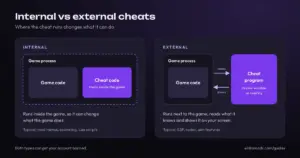
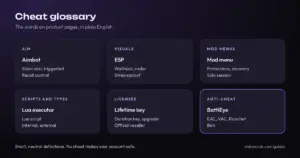
If you have read all this and still want a CS2 cheat, our comparison of the best CS2 cheats covers every one we sell, with plan lengths and live prices, and the CS2 category lists them all. Our guide to internal vs external cheats explains what each type does, and the cheat glossary defines VAC, bans and the other anti-cheat terms in a sentence each.
Compare CS2 cheats Check Product Status
Frequently asked questions
Is a VAC ban permanent?
Yes. Steam Support says VAC bans are permanent, can’t be appealed and are never removed by Steam Support. The only exception is a ban Valve itself finds was issued by mistake: it is then removed automatically, as happened to some CS2 players in January 2026.
Does a CS2 VAC ban affect my other Steam games?
A VAC ban covers the game where the cheat was detected. Steam only groups bans for some older Source and GoldSrc games, and CS2 is not in those groups. The ban still limits your whole account in other ways: you can’t send items from it, and you can’t gift the game you were banned in.
What is VACnet?
VACnet is Valve’s machine-learning anti-cheat for Counter-Strike. It looks for suspicious play in matches. Since August 2026, invited players label short match clips on a review site, and Valve uses those labels to train it.
Does FACEIT use VAC?
FACEIT runs its own anti-cheat, with a driver that loads when your PC starts, and it requires TPM 2.0 and Secure Boot. It also has its own banning rules: a cheating ban on FACEIT lasts five years. VAC bans are a separate matter, decided by Valve.
Is any CS2 cheat undetectable?
No. Valve and FACEIT both keep changing their anti-cheat systems, and any cheat, internal or external, with legit or rage settings, can lead to a ban. Nobody can honestly promise otherwise.
Related guides
 Best CS2 cheats in 2026MemeSense, Midnight, Nixware, Jupiter, Pellix and every other CS2 cheat we sell, compared by style of play, type, plan length and price.
- Internal vs external cheats: what is the difference?Where each type of cheat runs, what it can do, and examples from GTA V, FiveM, CS2, Rust and Apex Legends.
- Cheat glossary: ESP, aimbot, mod menu and moreAimbot, ESP, triggerbot, mod menu, Lua executor, BattlEye and more: the words on product pages, each explained in a sentence or two.

 Deutsch
 Français
 Polski
 Español